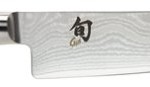
Experience has shown me that, that even though there are hundreds of knife styles available, most professional chef’s and enthusiasts always have just a couple of knives that they use regularly. You can perform almost any task with knives that fall into the first two categories. Do not feel that you need to run out and buy a large set of knives. Pick out one chef’s knife and one paring knife to start. Spend a little extra on each instead of buying a whole set and you will be happier in the long run. With that said, here is a guide of different styles of knives and their most common uses.
Chef’s Knife
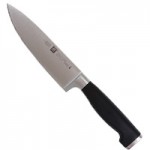
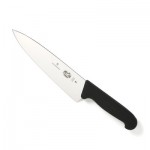
This is the workhorse of most chefs. I use mine between eighty and ninety percent of the time. It is the most versatile, able to chop, slice, dice and even fillet if necessary. This is the first knife you should purchase.
Chef’s knives are referred to by the length of the blade in inches, such as an 8 inch chef’s knife. The length of the blade is very important. The size of your hands matched to the correct blade length determines how well you will be able to wield the knife. Chef’s knives are available in lengths of 6, 8, 10, and 12 inches. A Longer blade is more difficult to control than a shorter blade. Shorter blades suit small-handed cooks. Those with big hands prefer longer blades for speed.
A chef’s knife has a bolster, a thick band of metal between the blade and handle. When you grip the knife properly, the bolster will help prevent the knife from slipping. Grip the handle of the chef’s knife behind the blade between forefinger and thumb.
Most forged knives have a full tang (the metal continues through the handle). You will see the metal (it will look like a sandwich)This is a matter of preference. A knife with a full tang will feel heavier and tend to be more balanced. This is strictly a matter of preference. There are many fine blades such as the Wusthof Grand Prix series that do not have a full tang, but are have a great feel.
A chef’s knife is often distinguished by the amount of the curve in the blade. Knives with a more curved blade will be easier to “rock” when chopping. While others have only a slight curve.
Check out my ratings of chef’s knives here!
Paring Knife
Whether you are peeling an apple, removing the ribs from celery or segmenting an orange, you will need a paring knife. When a chef’s knife is too big for the job a paring knife will be your knife of choice. There are only a few variances in design of these small knives. There are some with a serrated edge, good for cutting tomatoes. There are also blades that have a hooked tip, good for digging out blemishes in fruit or vegetables. The work horse though is the straight edge paring knife with a blade between 2 and 41/2 inches.
Utility Knives
When you have a job that requires a knife bigger than a paring knife but smaller than a chef’s knife, try a utility knife. They have blades a little longer, between 5 and 61/2 inches. They come in styles similar to a paring knife.
Carving Knives
Carving, or sometimes referred to as slicing; knives have long, thin straight blades. The blades are usually between 8 and 14 inches and are designed to carve roasts and poultry. Some carving knives have alternated hollow-edges. The hollows alternate on each side of the blade, so the entire blade has a hollow on one side or the other.) This creates air pockets that prevent slices from adhering to the blade and permit thinner slicing. Most carving knives have a pointed tip, great for reaching into tight places.
Boning and Fillet Knives
Boning knives are used to remove bones from poultry and other animals. They come in a couple of styles, straight and ridged for deboning or curved and flexible for working around the joints. Fillet knives are longer and thinner; this makes it easier to remove meat or the skin from fish.
Bread Knives
Bread knives will always be serrated. This feature allows them to cut through a crusty loaf of bread. They are not suitable for other uses as would easily tear up a piece of meat or fish. If you try cutting a tomato with a bread knife, you will end up with a mess.
Cleavers
Meat cleavers, as they are referred to, are just what they sound like. Designed to chop their way through the joints of animals when butchering. They are not designed to be subtle and produce a rough chop.
Steak Knives
There are two distinct styles of steak knives, one we use at home and the one you see at your local steak house. The steak knives we use at home look like utility knives and usually have a serrated edge with a wooden handle, the style used at restaurants is usually wider and longer. Either style may have a serrated edge which can tear through the meat.
Specialty Knives
Cheese Knives: These come in a variety of shapes and are used for cutting and serving cheeses of different degrees of density and hardness. Soft cheese requires a knife with holes in the blade to facilitate the release of cheese from the blade.
Garnish or Decorating Knives: This wavy-sided blade is used for slicing vegetables into decorative shapes.
Grapefruit Knives: An unusual shaped knife with a bent blade it is serrated on both sides and has a rounded tip for removing grapefruit sections without the ribs that are attached to the skin.
Tomato Knives: They have a thin narrow blade that is serrated which allows for a nice thin slice without damaging the tomato.